Sunday, June 30, 2013

Good-byes and Lessons


Somewhere, some place, we will see you again. 
Come back to Turkey soon--you’re an American, you don’t need visas to go anywhere. 
I know where to go when I come to the States: Detroit, Michigan!
You better be coming to my wedding. I’m mailing you the invitation. 
I hope you are leaving with good memories of us. 
You want to live in Turkey someday? --Well, maybe. Why you not just marry Turkish man? 
Don’t forget us, teacher. 

 After 3 unforgettable weeks introducing my family to tea and the call to prayer, I came back to Erzurum for one final weekend. Now I’m on my way home for real. I’m typing while sitting and sweating (air conditioners can make you ill) at Erzurum Airport’s only gate. The ride to the airport was beautiful. As a reward for 9 months of winter, Erzurumlu are given a perfect summer. The mountains are green and covered with wildflowers and the dry climate makes the skies cloudless. 

You’ll have to forgive me for this sentimental entry but I can’t imagine it another way. My good-byes to Erzurum have been quite drawn out. I said good-bye to my students when classes ended, I said good-bye to some of friends who left for their hometown while I was with my family at the beginning of June, and I made my final good-byes this weekend. For my heart’s sake, I have to follow-up every good-bye with a promise to visit. Especially, because I know that I will get the response, ‘inshallah’, God willing. And they are correct: there is no way to know today but God willing, I will visit. Two of my colleagues will marry in two years and I’ve asked them, with a wink, to set their dates close together so I can attend both. Inshallah. 

When I introduced my family to my boss, Muzaffer Bey, he told my parents that he was disappointed that I had changed my mind about staying for another year. He continued, however, that he knew why I had decided to go home. He motioned to the five of us surrounding him, drinking one of our first of many teas together and said, “Because of you all. I know that Helen misses you.” He is right. I thank him and many of the Turks I met this year for reinforcing that truth: family is the most important. My parents taught me this truth  by raising my siblings and I in the loving way they did.  Before I came to Turkey, this was balanced in my head with the American emphasis on individualism and self-empowerment. Now that I’ve had a year in another culture, it’s easier to comment on my own. I see that in America, children are encouraged to go far away if it means better education or a better opportunity. Missing family reunions or weddings are excused for professional or educational reasons. I don’t deny that such ideals have a place but living in a society where family was truly, truly number one has had a true impact on me. 

If I asked my 18-year-old male students to describe the most beautiful woman they know, I can guarantee that most, if not all, would describe their mother. For traditional Turkish marriages, more emphasis is placed on the engagement than the wedding because that is when the families of the bride and groom meet for the first time. It was not uncommon for my students to answer “homesick” before they answered “fine, thanks, and you?” when I asked them how they were doing. My girlfriend Nermin’s mother came to visit from Istanbul for a month this year and it was perceived as too short a time in one year to spend with your mother. And no one seemed surprised at all when I said that my family would be staying for 3 weeks. 

I don’t mean to be critical of the American way of living the “family is number one” adage and if it wasn’t for the American values of ambition and stretching oneself, I would not be sitting in the Erzurum airport right now. But as I reflect at all the lessons Turkey has taught me this year, I keep coming back to this value on family. 

Now, I will not hesitate to confidently state that one of my most important long term goals is to be close to my family. I want to be successful and I want to have a meaningful career but I am also willing to amend that path to see my family easily in the long run. 

To my Turkish friends and students, thank you for teaching me to be proud of how much I love and want to be with my family. And thank you for treating me like a daughter and a sister since my family was so far away this year. You taught me, guided me and loved me and there is not way to truly express my thanks. Okay, I am now on the plane, crying and breaking regulations by keeping this laptop on. For the safety of this plane and for the comfort of the man next to me who does not know what to do, I will close my computer. 

What I will miss and not miss . . .


An incomplete list: 

I will miss çağ kebab. Lamb roasted sideways on the fire and served with flat bread, peppers and yogurt by waiters who know your drink order because you are one of four foreigners to enter their restaurant. An Erzurum speciality. Yum. 
I will not miss been nearly toppled over by teyzes (aunties) who seem to have no sense of personal space or possibly peripheral vision under all their layers of clothing. 
I will miss the kindness of bus drivers, waiters, government workers and handymen. No task seemed too great for me to receive a rude response. I’ve been “given a break” on everything this year. When I was late for the bus, drivers waited. When I was a few lira short, I was told not to worry about it. When I ordered a drink not in stock, a little boy was sent out to fetch it.
I will not miss the over the shoulder stare from the person behind me in line every time I withdrew money. I guess knowing how much money the young foreigner had was very important for the city of Erzurum to know. 
I will miss being a guest. After 9 months, I no longer deserve the status (I have a residency card, not a tourist visa!) but I can’t say I stopped enjoying the perks. I wasn’t charged for my excess baggage weight today at the Turkish Airlines counter because I was guest to Turkey. 1. No way Delta is not doing that, not even to welcome me home. 2. How is that sustainable business practice for an airline? 
I will not miss the toilets. I will spare you the details but I will certainly not miss the toilets. 
I will miss trying to speak Turkish and the victorious feeling of being understood. 
I will not miss not knowing what people are talking about, especially when I’ve already asked them to explain. 
I will miss all the Turkish phrases that are appropriate for specific situations. Geçmis olsun: said to a sick person or to someone who just did something difficult, from taking an exam to bumping his or her head. Afiyet olsun: said before eating, after eating, while eating, when you are walking to lunch, when you are buying food. Kolay gelsin: said to someone who is doing work from sweeping the floor to working in a shop. Selam söyle: said when someone is talking to or soon visiting family, it means “say hi”. I will also miss the praise from my students when I used one of these appropriately. 
I will miss Turkish Airlines. The best airline in Europe...and Asia. (Actual slogan)
I will miss the extension of activities. In Erzurum, dinner invitations turn into sleepovers, breakfasts end at 5 pm. Social events never seem to end unless I had a genuine excuse to leave. (Side note: Having to skype my family, prepare for class or being tired were never adequate excuses. I learned that I could just use my hosts’ internet to skype, prepare for class while they did the dishes, or take a nap in their bed!)
I will miss the lira. And getting a paycheck, I suppose. For now at least. 
I will miss the tea after dinner. But never fear, friends and family, I have a double boiler teapot (necessary) and a kilo of tea from the city of Rize (only the best) in my overweight suitcase for after dinner teas in the future. 

Friday, June 7, 2013

Benim kız kardeşim geldi! My sister came!


Being an abla (elder sister) comes with its struggles and rewards. Its struggles, like your little sister forgetting to pack her toothbrush not once but twice--even after you buy her another one, are often comical. Its rewards are many and powerful. The rewards: Colette agreeing after only one phone call to come to Turkey a week before the rest of the family to help me pack and to travel  together. Accepting and understanding my superfluous tears as she describes Kathleen's wedding to me (Am I extra emotional this week about leaving Erzurum, my friends, and students? Certainly.). Not caring that our mini bus will not leave for another half hour because there is no where she would rather be than staring at Akdamar Island on the shores of Lake Van--plus, we have some almonds to eat. And finally, telling me that she knows I am busy but she wishes I would blog more because she likes it. And she would be a good guest blogger. So here she is. Ladies and gentlemen, Colette Berg!

It seems that all I have done since I arrived in Turkey on Sunday is eat, drink tea, and meet kind people. I tell you, this is my kind of country. Everywhere we go in Erzurum, people greet us with a cheerful hello, ask my name, and offer us tea. I love getting the chance to see the strong community that my sister has here--from her enthusiastic students to her co-workers at the university to the waiters at the Fulbrighters' favorite restaurant. Yesterday, while drinking tea with HM's boss, (this was our fourth out of seven cups that day), he lamented that HM is going back to the US soon. However, he admitted, "Family comes first." I must agree. While I am so excited to see the sights of Turkey, this is a small joy compared to the joy of being with my Abla again.


My most memorable day so far was going to a mangal--barbecue--with HM and Nermin's English students. They had just completed their final English exam, so no doubt their brains were fried, yet many of them still made conversation with me, with many gestures to facilitate understanding. We ate dozens of chicken wings with lavash bread, then goofed around on the playground. My proudest moment was during a volleyball game. I heard the phrase "salaam aleikoum"--peace be with you--and gave the response "aleikoum salaam"--and also with you. Ironic that my first successful Turkish interaction occurred in Arabic. Everyone clapped, happy to hear teacher's sister say something comprehensible. I had learned it from one of the Orhan Pamuk books HM recommended to me. As HM promised, traditional dance followed the meal. I learned a dance, realized that I have been snapping my fingers wrong all my life, and then did the Cupid Shuffle with HM, Nermin, and a few students. The best part about the afternoon was just getting to hang out with a bunch of people who just finished freshman year of college, just like me.


We decided to go to Van for the weekend, and I got the full eastern Turkey bus experience. An elderly Teyze--aunty--sat down in the aisle at my feet, and later fell asleep with her head almost in my lap. I slept for most of the bus ride, and when HM asked me if i was uncomfortable and wanted to switch places, I replied, "I am asleep right now," and promptly closed my eyes again.


Today we explored a beautiful Armenian church, and tonight we'll visit a castle! Insallah, the next few weeks will be as magical as my first few days in Turkey.

Tuesday, May 7, 2013

To my Mercy Girls

Blogging this semester clearly has been a struggle for me. For good reasons, I think. As my days left in Erzurum dwindle, I’ve doing my best to spend the most time I can with friends and students and see as much of this country and this part of the world before I’m back on the other side of the ocean. I’ve had some wonderful trip this spring: north to Trabzon for Easter, south to the beaches of Cyprus, further north to Kiev to visit the Engstroms and celebrate Orthodox Easter and I have two more trips scheduled for May to the beaches of Bodrum in the West and the sandy Southeastern cities of Adiyaman and Mardin. (Personal accomplishment: I have finally posted facebook photos of these travels (although it’s 11 pm and lesson plans still must be written!). I’ve been doing my best so that my students do not suffer from these trips but clearly my blogging has. 
I was asked to write a letter for the development office at Mercy about my time abroad. The request was to write about how my Mercy education has impacted my life in Turkey. I actually enjoyed writing it and thinking about the 5 Mercy values (Mercy girls, say them with me): mercy, justice, human dignity, option for the poor, and service. Although I’ve certainly discussed these topics already with many of you who follow my blog, I wanted to share the letter here. 
To my Mercy Girls All Over the World:
I spent this past year as a Fulbright English Teaching Assistant in the city of Erzurum in Eastern Turkey. I teach English to Turkish students, some of whom are first year engineering students at a university and others are practicing physicians at a local hospital. I'm one of only four Americans in the city and only a handful of English speakers of any kind --although my students are slowly joining that group! Erzurum is a snowy, conservative city in the mountains--a far cry from Mercy High in suburban Detroit. With reflection, however, I realize that the values I learned
between those North and South halls on Eleven Mile are still inextricably woven into my experience in Eastern Anatolia.
From Turkey, when I think about Mercy, I think about the Mercy girls who were my closest friends. In Erzurum, unmarried men and women interact socially less often than in the U.S.A. In Turkey, it is only socially acceptable for an unmarried woman like me to have girlfriends. Being a Mercy girl, I see something wonderfully familiar and natural about birthday celebrations with my Turkish friends: there are cupcakes, movie nights and sleepovers.  Friendships between females in Turkey are similar to those at Mercy in other ways too. At work each day, one of my co-workers inevitably asks everyone on the floor where we should eat and a collective decision is made, no one is left out. When someone has an idea about going to a movie, she often will post the idea on her facebook page so anyone who wants to come, can. I learned to value such inclusivity and communication at Mercy--where I was taught to be a good friend. I miss my Mercy sisters everyday but thanks to the example they set for me of friendship,  I know I will one day miss my Erzurum sisters too.
After sisterhood, the next word that comes to mind when I think of Mercy is diversity. As one coming from Detroit, I appreciated the effort made at Mercy to attract a student body from all communities. Mercy's teachers and administrators taught me that diversity did not simply appear after providing enough bus routes, but through conversation and intentional actions. Programs like Ethnic Bazaar and classes like Race Relations taught me that diversity must be valued but also worked towards. I have mulled over these lessons many times when I've engaged my students and co-workers in conversations about diversity in Turkey--a topic that is never easy. Turkey's history with minorities is a painful one as ethnic groups were forced out of the country or killed during its foundation. Their troubles are far from over and can still be glimpsed in my classrooms when the seating arrangement is sometimes based on ethnicity. Turkey's relationship with diversity is far too complicated for me, a foreigner in Turkey for only one year, to completely comprehend, but when
conversations on the topic turn pessimistic, I often turn inward to the ideals I learned at Mercy--that unity in diversity can be achieved through thoughtful discourse and process.
Next--faith. The faith that I established at Mercy has grown this year in Erzurum, in the way I hope it continues to grow each year of my life. The faith tradition of my neighbors, students and friends in Erzurum is nominally very different from the faith I cultivated at Mercy. The closest
Catholic Church is a five hour bus ride to the north. The minarets of three mosques that I see from my apartment window are signs that demonstrate the faith of this city. I am consistently inspired by the piety and devotion of my students, all of whom are Muslim. The care they take to say their
prayers on time and the meticulous preparation for those prayers reminds me of the importance of prayer and reflection in my own life. I remember my Kairos leader reminding us that God can be found in all actions made with love. I recall this truth when I see the love for God in the religious
practices of the people around me.
I still aspire to be that woman who Catharine MaCaulay and all the teachers I had at Mercy expect me to be, a woman who makes a difference. With their help and the example and friendship of all my Mercy sisters, I think I am on the right path.
Forever a Mercy girl,
HM

Friday, March 22, 2013

Home and Back Again


It’s been long enough since I last blogged for me to forget my password but I will not waste time with apologizes and jump right back in. I left Erzurum for 5 weeks in January and February and had a lovely time visiting the Labaune family in Paris, Paule in Nancy (6 years have passed since we stopped sharing a room but we have wonderfully not run out of things to talk about), Karolina in Warsaw and Danielle in Istanbul. My journey ended in Detroit. I went home for my Dad’s investiture and therefore conveniently saw every person in my life whom I love and had also traveled to Detroit for the same purpose. It was as perfect a trip for me as it sounds. The highlight was certainly w the people I got to see, even though I feel very fortunate that I saw some new parts of the world as well. 

I’ve been back in the Erzurum swing of things for one month now. And in that month I’ve heard from my students: “Bahar geldi inşallah, teacher!” To which I respond, “Yes, I hope spring is here, too.” It’s 35 degrees outside right now and the sun has set, such a nice reprieve from the subzero days of December. My window is actually open since I don’t control my heat and I think my landlord still thinks it’s in the negatives. 

I’ve been meaning to blog for a few days now, so I’ve “written” the beginning of several different blog entries in my head. I’ve decided to combine them. Since I never made it past the first few paragraphs of this mental writing, I will jot them down here as a few vignettes of my first month back in the ERZ--as I’ve recently started calling it. 

“Step-Touch-Mambo”
I joined a gym last semester and I was very confused when it closed two weeks later. I saw the light on as I walked past two weeks ago. Armed with more confidence in my Turkish language skills and the desire to work off my post holiday kilos, I walked in with the plan to ask to revive my former membership. It turns out the gym was renovated and under new management. Any hope of explaining that I once was a member of this gym was lost soon after I started my conversation with Nurcan, the feisty 4 foot 10 proprietor who did not speak without shouting (was it because the music was so loud or was she just used to yelling at people to run faster?). By the end of our talk, however, I signed up for twice a “Step Arobik” class for the equivalent of $25 a month. 
I’ll have to go back a bit in time for this part of the narrative. In October, during one of the first times I met with the other Fulbrighters in Eastern Turkey, we made two lists entitled “Things Turks are Good at” and “Things Turks are Not Good at”. At the time, it was both a bonding experience and a coping mechanism. We were all going through similar experiences in different cities in Eastern Turkey and we were trying to make sense of the sometimes unexplainable behaviors going on around us. We’ve since edited and added to those lists, our knowledge and understanding definitely improved since October. On the top of the “Not Good At” List was plumbing. On top of the “Good At” list was dancing. There was debate. Some of my colleagues believed that there must be some Turks that can not dance. They were wrong. And my Step Arobik class is proof. Whether it is to the sounds of Shakira, Usher or Tarkan, this group of women glide effortlessly off their step blocks to the floor and back.  Salsa, hip hop, belly dancing--boom, easy. Sometimes I think the teacher focuses a bit too much on everyone staying on beat than actually sweating. But hey, I’m here for the cultural experience.

Learning Arabic
Another addition to my schedule this semester is my new Turkish Language for Foreigners course. Finally! I came in with the goal this semester to not stop until I found a course to force myself to be more structured with my learning. I ended up walking into one--literally. The printer in our department was broken and I was advised to go to a man named Ahmet’s office and use his. Ahmet spoke no English...because he teaches the new Turkish course that will start Monday! Bingo! I am one of three students in the course. The two others are men from Syria. I occasionally meet Syrians in Erzurum and such encounters are always shocking reminders for me to count my blessings and well, because I feel I can do nothing else, pray. My new classmate, Soheb, told me that he and his wife were here in Erzurum but his parents and brothers are still in Aleppo. “Are they safe?” I asked. “No one in Syria is safe,” he replied. I am grateful that saying such things as, “I am praying for your family and your country” are appropriate to say in Turkish cultural (and presumably Syrian as well) because I did not know what else to say. Yesterday, our teacher was explaining the proper use of articles and adjectives when speaking about well-known people, i.e. facts that everyone knows. His examples: 1. Atatürk was a brave man. 2. Assad is a cruel man. 

Erzurum's own Shopaholic
And to lighten the mood, a tribute to my officemate, Aysel--who I absolutely adore. This is what I walked into this afternoon. She loves to shop. I asked her what she did before the mall in Erzurum opened three years ago. And she said, “I do other things besides shop!” But she could not think of any examples. 


Being a Good Host
Last weekend in preparation for other some other Fulbrighters to come to Erzurum to ski, I told Korey I was going to clean my apartment like “a Turkish woman.” He laughed and said that I was going to be up all night. I was not up all night but my apartment was also significantly below a Turkish woman’s standards. I’ve blogged at length about Turkish hospitality.  I have not blogged enough about the effort put into being a good host in Turkey. Turks do not just invite you over. They invite you over to a spotless home and a perfectly prepared meal. And as I become closer to some of my Turkish friends here, I am not, as I expected, invited over without such preparations. I am simply informed of the process. “Hey, Nermin, can I come over?” “Sure, come over at 7.” “Seven? It’s four o’clock right now.” “I know, I need to clean.” Three hours sounds excessive, but if you saw how spotless her home was, it makes sense. 
I’ve had conversations with some of my Turkish girlfriends about how the increase of women in the workforce  has not diminished their duties at home, it has only made planning for guests more necessary. One of my co-workers joked, that when she was growing up, guests could just drop by because her mother stayed home and therefore had more time to keep the house in perfect condition. She continued that guests need to give her fair warning for her to get her house in “acceptable” condition. Knowing how much effort my friends put forward just to have a casual sleepover make me appreciate them and this culture so even more. Maybe I will someday be invited over to a messy home, but at this rate, it seems like it will be a while. 
Speaking of, I am receiving a guest tonight. She is a friend from Turkish class in the U.S. and is studying abroad in Istanbul for the semester. And-ah!-she arrives in 4 hours, my floor is not washed, her bed is not made and dinner is not prepared. Whether those tasks will ever be achieved is uncertain. I’m not quite a full “hanım efendi” yet but I’ve learned quite a bit this year. Regardless of my success, I only have 4 hours--I better get started!

Sunday, January 13, 2013

Ellerinize sağlık = Health to your Hands


       I’ve lived in Erzurum for four months now but this was my first weekend where I was  officially (or I suppose I don’t really know if that’s accurate) the only American in the city. Korey and Elizabeth took off for break on Friday. Emily is visiting another Fulbrighter a few hours away before returning Monday to teach our remaining 8 hours before we take off for break as well. I imagined this weekend would be full of final lesson planing and preliminary packing but instead it was full of reminders of the hospitality that made me fall in love with Turkey in the first place. 
           I don’t believe that I announced my singular status this weekend to many people but the news seemed to spread quickly amongst my acquaintances here that I was “alone” and should be duly taken care of. It’s Sunday afternoon around 2 pm and this is the first moment I’ve had to myself since Friday afternoon. And I’m waiting for a text from Zeynep, a student in the English Language Faculty who is (ready for this?) the daughter of Elizabeth’s boyfriend’s mother’s patient’s friend and has therefore acted like a member of the family. She is coming over to make dinner and then join me to see The Hobbit at the mall. I spent Friday night with a fellow teacher who had me over her house to meet her sister and roommate and drink wine and watch music videos. She is the only other woman at school who drinks and we had been talking about having a sleepover since I first arrived but finally scheduled it for the last night of the term. I got up early the next morning to ski with one of my doctor students and his family in Konakli, about 30 minutes away. I was the coldest I have ever been in my life but the view from the top of the ski lift was worth it; the mountains were so completely white, they looked like an ocean. I had dinner with Dr. Mehmet and his three children and they then dropped me off at the mall where I met fellow teacher and shopaholic, Nermin. We shopped and we then went to her house to watch “The Wedding Planner”, gossip, drink tea and eat chickpeas. I was once again extremely grateful for how warm the apartments are kept here.  I know I’m not “thinking globally” when I’m saying this but when it’s 10+ degrees below zero, you are fine with some smog from all the burning coal if it means a warm apartment. This morning I had breakfast with the women from my doctors’ class at Dr. Zeliha’s home. I don’t know how she manages a life as a full time doctor with three small children where she can still invite me over for a delicious spread of homemade bread, cheese, olives and eggs at ten in the morning. 
     This weekend reminded me of one of my first weekends here, when I was shuffled from person to person and home to home. There was something distinctly more comfortable and pleasant about this weekend compared to those first ones though. Instead of fielding questions about why I chose to come to Erzurum and what I know about  Turkish politics, I was asked much more personal ones like if I would see my sister when I went home and how my skiing skills were coming along. I am more comfortable as well. Even though I’m still learning about Turkey and about myself with each interaction, I am not as googly-eyed.  I think I am actually taking in more since I have a bank of basic knowledge. From simple things like being able to distinguish a male from a female name when someone tells me the name of their child to knowing that helva is usually store-bought, not homemade, to more substantial knowledge like what someone is doing when they excuse themselves to the corner to pray, I can ask more competent questions and have deeper conversations. This weekend was a lovely reminder of that. Even knowing a few proper phrases to adequately thank your host for their hospitality can make a big difference. I constantly say thank you” in Turkish to express my gratitude but this surprisingly and unfortunately does not translate very well. Instead, when someone feeds you, you should say what translates as “health to your hands” or just “may God bless your family.” When someone visits, you wish them health to their feet. When someone drives you in their new car, you congratulate them on their purchase. I heard myself using these phrases (even if still awkwardly in my Turk-English) and I could tell that it mattered-I could thank them in a way that meant something to both them and me. 
           These feelings harken me back to a conversation I had with Salih, the husband of one of my professor’s at CUA, on the Red Line during one of my commutes back to Catholic from Georgetown sometime last year. Salih is the reason I’m in Erzurum right now. He hooked me up with his friend who organized the trips to Turkey last summer, my first experience in the country. He further inspired me to take Turkish and apply for the Fulbright. Anyway, he was telling me that he had started taking Arabic classes and was telling me about his struggles with learning the new alphabet. I asked him why he chose to take on another language when he already speaks three. He told me it was necessary for his studies in comparative religion but also cited a proverb (was it Turkish? was it Arabic? I can’t remember) that said something along the lines that when you study a language, your soul grows. I liked the phrase then. I think I understand it now. Disregarding the literal meaning of language for a second, I do believe that with the greater understanding of Erzurum, of Turkish culture, and of Islam that I’ve gained these past few months, my soul has grown. I’ve been able to connect with people on a deeper level. Turkish hospitality has remained the same, the way I’m able to receive it has changed. And I’m very grateful for that!

What skiing on the coldest place on Earth looks like.

Friday, January 11, 2013

Essential to English Language Learning

My students have taught me so many folk dances over the semester, I decided to teach them the "Wobble" on the last day of class. I wish I had video evidence of me attempting to do the "Kolbasti" and "Horon" as well, my students only chose to record this one. Next term.

One of my students told me that if climate change was called "global freezing", people would pay more attention. It's -11 F and I'm about to go skiing. Why did people decide to settle on this frigid steppe? Paris, Warsaw and Detroit are going to be balmy.

Saturday, December 29, 2012

All I Want for Christmas is You


              December has been a slow month for blogging. It’s been both busy (4 new hours a week of teaching medical school professors) and a bit melancholy. For the first time in my 21 Christmases, I was quite happy that this one has passed. I spent a lot of December worrying about how it would be to not be with my family in a place that does not celebrate the holiday.* In the end, it was fine. Korey, Elizabeth, Emily and I had a nice little gift exchange at the ski lodge in the evening, I had many conversations with my co-workers all day about why I care about Christmas at all and taught a Christmas lesson to my students. I used vocabulary from Mariah Carey’s “All I Want for Christmas” song. Afterwards, they had to write what they wanted for a hypothetical Christmas, write their sentence on an ornament-shaped piece of paper and tape it to the board in the shape of a Christmas tree. (Here is where I admit that some of the silly crafts I did as an RA have real life application.) Their answers were creative and enlightening, one of my favorite activities I’ve done this year. Here are some examples. 

I want for Christmas many things: car, money, everything.

All I want for Christmas is GRADUATION.

I want for Christmas: health, money and love. 

I ask people to be good at Christmas.

I would like a red car.

All I want for Christmas is to win the lottery.

Anything. I like myself.

All I want for Christmas is to see my family and success. 

All I want for Christmas is to go to the bar, listen to live music. No sleep.

I want calm and to be with my family.

Peace, success, health. 

No war! (with two fingers for peace drawing)

All I want for Christmas is happiness, new work, a lot of money, very good exam, hot weather!

I want a robot that does my complete business. (My favorite!)

All I want for Christmas is to become in love!

To be awesome!

Family, health, money, tranquility, happy, prosperity, affair, graduation. 

All I want for Christmas is “Accomplishment.”
I will go to mosque and I will make prayer to God for all of people. 

All I want for Christmas is “LUCKY”.

All I want for Christmas is to learn and speak English :).

Prestige!

I want to be with my Angelina Jolie.

All I want for Christmas is an old, sweet Volkswagon Beetle. 


                  I could go on and on. I hope you had a great Christmas. Iyi Yıller! Happy New Year! Three more weeks of teaching and then a five week break, hopefully another entry will come before then. 

Some of my favorites with their Christmas tree.  

Helin, Helen Marie, Hüriye and Gülşah.

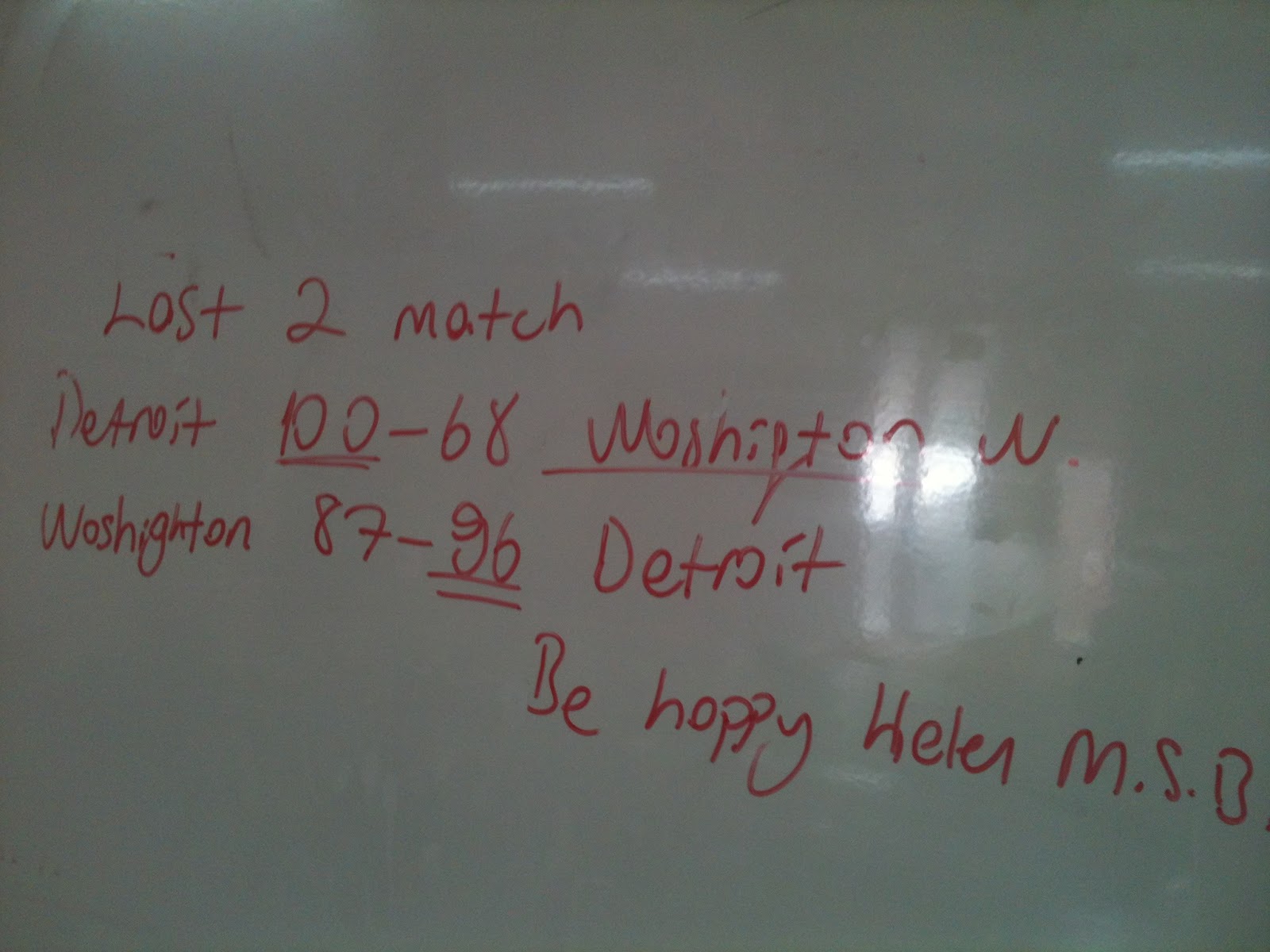
A message written on the board by Caner during our break. He wrote the scores of the last two Pistons games and "Be happy Helen M.S.B."

My lovable Tourism students. 


*Side note: There is a strange misunderstanding in Turkey about Christmas and New Year’s. Because New Year’s is a state holiday here and the malls and certain shop displays have been infiltrated with Western Christmas symbols, many believe that the state holiday on January 1st is also Christmas in the West. I’ve give up trying to explain to my students that it’s actually December 25th because they have been hearing that it is a week later their entire lives. Instead, I just say, “In America, we celebrate Christmas on the 25th.” This mix-up lends to a lot of strange replies when I ask people how they celebrate New Year’s. “I don’t celebrate that holiday, I’m Muslim.” Oh man. 

Friday, November 30, 2012

Erzurum PR


One of my new, and rapidly very dear, friends here, Nermin, is in charge of American Corner at Atatürk Üniversitesi. To avoid the risk of insulting my employer, the State Dept, I will not go into too much detail about my feelings about the Corner. I’ll just say though that it is a room in our Foreign Language Department stocked with books about Broadway musicals and Barack Obama and DVDs narrated by Ken Burns. It’s where my weekly “English Music Club” takes place and as well as various speakers, and different events that either we or Embassy visitors host. Anyway, the greatest downside of the Corner in the eyes of those who operate on the daily are the reports that must be written to the Embassy about its activities (and really all activities involving Americans and Turks in Erzurum) on a frequent basis. Nermin has taken to outsourcing this task to me and I’ve been happy to oblige. Here are parts of our last two reports on Thanksgiving (which actually took place in  Elizabeth’s and Emily’s apartment, not the Corner) and our Halloween Party for our students. 

Thanksgiving in Erzurum
This Thanksgiving, the American ETAs living in Erzurum celebrated Turkey Day with turkey in Turkey. Although the turkey (affectionately named Hank Hindi) was certainly the centerpiece of the feast and the source of many jokes and shameless puns, the heart of the celebration was the people.  Nine American Fulbrighters from Eastern Turkey descended on Erzurum for Thanksgiving weekend to celebrate with the Erzurum ETAs and their new Turkish friends. On Saturday, a group of 25 gathered for a feast of mashed potatoes, stuffing, börek, corn, quince compote (cranberries could not be found), sauteed eggplant and of course, the turkey. Hank (thanks to the determination of Erzurum ETA, Elizabeth Dratz and the kindness and resourcefulness of a fellow English lecturer at Atatürk Üniversitesi, Alper) was alive only about 12 hours before he was eaten. Hank belonged to Alper’s friend who was willing to give him up to help the Americans in town celebrate their holiday. It was Elizabeth’s first time she cooked a turkey for Thanksgiving without her mother’s help and her first time she had seen one slaughtered. Before Hank was enjoyed, all the guests said what they were thankful for this year. Many of the Americans were thankful for the generosity that they had encountered in the short three months they had been in Turkey and for friendships they had begun to form. The Turkish guests were also grateful for their new American friends and for the opportunity to share in this celebration. The dessert selection was symbolic, revealing that this night was not about one culture passively displaying their tradition to the other but was an organic merging of two cultures celebrating together. Since the Thanksgiving Party fell close to Aşure Günü or the day to celebrate the landing of Noah’s Ark, aşure pudding, a delicious, sweet hodge podge of rice, dried fruits and nuts was prepared in abundance by one of the guests and enjoyed by all. Along with the aşure, the guests indulged in apple pie, baklava, pumpkin pie, Gumuşhane pestil and köme, and chocolate chip cookies. 

Halloween in Erzurum
On October 31st, about 35 students of Atatürk University attended the American Corner Halloween Party. The night was was filled with games led by English lecturers and Fulbright ETAs, dancing that spilled out into the hallways and of course, lots of Halloween candy. Students bobbed for apples with a competitive zeal that the ETAs noted far surpassed what they had seen at Halloween parties in the States. Some students opted to be blindfolded as they played pin the nose on the jack o’lantern while others wrapped their classmates in toilet paper to mimic mummies. As the sounds of “Thriller” and “The Monster Mash” drifted around the room, students laughed and poked fun at those that struggled to eat donuts off a string. Not many attendees donned costumes but there was a cheetah, a witch and even the late Bariş Manço in attendance. The climax of the night was certainly the dancing. Trading off between the hustle and other dances led by the Americans and traditional Turkish dances by the students, students participated in a spontaneous dance exchange. Needless to say, many are counting down the weeks until Thanksgiving and the next large American Corner event.

Tuesday, November 13, 2012

Salı Günü, Tuesday.


Hello family and friends! Tonight, I would like to tell you about my day in Erzurum. 
I woke up at 6:15. It sounds early but the sun had beat me. Turkey only has one time zone so cities in the East like ours enjoy very early sunrises and early sunsets. I’m grateful that I don’t teach afternoon classes because it is usually dark before 4. I’m looking forward to the winter solstice. I made some Nescafe. I’m in the market for a French press. 
As I waited in front of the fruit stand where Aysegul usually picks me up, the manavci (fruit seller) insisted that I wait inside his store because it was way too cold to wait outside. We have experienced our coldest temperatures this week--in the low 40s. He also told me that I would learn more Turkish inside than I would outside. He had clearly noticed my terrible accent in mornings past. I sat on the chair behind his register and ate a pastry for a few minutes as he bustled around stacking tomatoes and speaking to me in Turkish. Probably giving me advice about how to stay warm but who knows for sure.
I arrived at school ready to knock out my four hours of teaching. On Tuesdays and Thursdays, I teach two hours of engineering students and two hours of tourism students. Although both fields require an English proficiency, engineering students must score much higher on the college entrance exams and the difference in my two classes’ speaking levels reflects that difference in scores. What the tourism students may not have in vocabulary and grammar, however, they certainly make up for in their enthusiasm and competitiveness.
In each class, I teach (or sometimes attempt to teach) my students how to speak about two topics. Today our topics were “Food Around the World” and “The Movies.” Highlights include: When I was explaining that enchiladas were bread rolled up and stuffed with meat and cheese, one boy chimed in: “Oh, like a cigarette.” Sure. When discussing pizza, I felt it suitable to explain the beauty of a Little Caesars’ “Hot and Ready”s--especially in a city like Erzurum where there is no such thing as fast food. I went on at length about how one could walk in and take a pizza and only be $5 poorer. One of my very serious students stood up in the back of the room, took a deep breath and said: “Teacher, this pizza--maşallah.” Maşallah is a phrase which roughly translates to “may God bless and keep.” It’s usually reserved for newborn babies. But apparently also appropriate for Pizza Pizza.
I joke that my mornings are filled with teaching and my afternoons are filled with drinking tea. This is actually the truth, not a joke. I drank my first glass (and they are served in glass cups here) with Elizabeth and Korey at the Medical School cafeteria with our menemen, a casserole-type dish of tomatoes and eggs. When I got back to school, Muzaffer Bey, the vice-director of the Foreign Language School invited me into his office for a glass. I think of Muzaffer Bey as the grandfather of Erzurum. He has bright white hair. He has taught English here for his entire life. Our boss, Mehmet Bey, had him as a teacher for his first year of high school. He always stares out the window as he speaks to me in his office. He has a look in his eyes like he is gazing at the mountains that surround Erzurum and thinking about all the people he has influenced here. This would be really cool if he actually had a view of the mountains but his office is on the first floor so he can only see cars in the parking lot.
I went upstairs and drank a glass with my office mate, Aysel, as I graded speaking presentation topics. When I went downstairs to print some grading sheets, I refused a glass with Zekir Bey the printer. I instantly regretted it. He is someone I should befriend but I had left my office door unlocked upstairs so I felt like I could not stay. I drank my fourth cup of the day with Zeynep, one of my partner teachers. She teaches my tourism students grammar and reading. She wanted to hear how they were progressing. I was happy to tell her that they are trying very hard and was also secretly pleased when she agreed that one of the best students is a girl named Helin. She’s pregnant and as I was leaving, she told me that the next time I stopped by, she’d love to discuss what it is like to give birth in the U.S. I’ll have to do some research on that one. 
After dinner with Emily and Korey, Emily and I embarked on what we knew would be an Erzurum adventure. As I mentioned, we had agreed to give English lesson to the family that owned Guzelyurt, Erzurum’s fanciest establishment, but still did not know many--or any--details about these lessons. We were told to arrive at Guzelyurt at 7 where Mervlat the waiter would meet us. Emily accurately described our experience with Mervlat as something out of an old movie. The bar is empty. Classical music is playing. A man wearing a suit beckons you urgently over to two empty bar stools. Tea is poured. A phone rings. Just as urgently, you are beckoned down some back stairs. You introduced to another man in a suit. You are told to sit  inthe back seat of a car. You have not idea what is going on since everyone is speaking a different language. You are suddenly zooming down the city streets. This is where my narrative breaks down. I really can’t imagine Cumhuriyet Street as one in Paris or Rome--but up to that point, we felt like film noire stars. The driver (who turned out to be the owner’s brother) drove us to Dadaşkent. The suburbs. Although it was dark, I could tell it was the nice part of town. At a first floor apartment, we were greeted by Sibel and Dilay. Dilay is 12 and she will be our pupil. From the mere hour and a half I spent in their house, I could tell that Sibel is the ultimate Turkish Tiger Mom. She is a doctor at a private practice in town. Her apartment was impeccably decorated. She made us tea with such haste, I did not know water could boil that quickly. She does not speak English so she immediately put Emily on the phone with her sister who does. I heard the conversation secondhand but apparently Sibel wanted to know about our qualifications for teaching her daughter. Emily told her that we were English teachers at Atatürk. “Wait, are you Fulbrights ETAs?” said Sibel’s sister, “I work for the Fulbright Comission in Ankara.” Yes, just to prove that the world is smaller than I already thought, we had met this women during our orientation in Ankara. She is the accountant for Fulbright’s programs in Turkey and knew details about us from our applications long before Sibel handed Emily the phone. 
Sibel wants Dilay to be accepted to Robert College (actually a high school) in Istanbul in three years. Robert College could probably be described as Turkey’s Exeter and English fluency is required. Dilay is well on her way. She can understand me better than the majority of my students and her accent is flawless. I’m looking forward to spending an hour with her each week and figuring out how to keep her attention. We might try to read Harry Potter, she told us she enjoys the movies. Sibel was lovely to us as well. Although I emphasized her intensity, she seemed very happy to meet us. When she drove us home, she told us about a Blues Festival--the first in Turkey--that was visiting Erzurum on Sunday. “Tickets are hard to get but my husband has some if you would like to come.” I think we may have accidentally fallen in with Erzurum high society.
For those of you that made it to the end of this account, it is now later than I would like to go to bed to be rested for my 8 a.m. class--and what will follow. Luckily, however, I have no doubt that my tomorrow will be charged with the caffeine from the glasses of tea. Inşallah.

Wednesday, November 7, 2012

Obama Hoş Geldin!


Ah, Erzurum in the fall is even more beautiful when its four American residents are assured that their leader will be leading for four more years. I did not realize how stressed out I was about the election until I had my state of cheerfulness this morning to compare it to. I had given half hearted attempts to give a lesson about the elections in my classes on Monday and Tuesday but was met with blank faces. I found it close to impossible to  explain the differences between the two candidates in a way that interested my students and used only their limited vocabulary. I kept finding myself repeating the statements like “But the race is very close. We do not know who will win.” Clearly, that was where my mind was. 

Today, I rolled into Derslik 1-7 with a huge grin on my face. I think my students sensed this change in my attitude because they (my “Muhammad” class, led by five lively boys all with the same name who insist on a constant din of Turkish whispering) listened so attentively, I barely recognized them. Korey and I had been up since 4 am watching the votes come in. I should have know it was a good omen when I woke up the exact minute MSNBC called Michigan. The first call to prayer of the day began when New Hampshire went blue. And when Ohio--and the race--was called for Obama, Korey and I were jumping around my apartment. Ayşegul, my coworker who drives me to work, said playfully as she picked me up, “I hope there are other things in this life that make you this happy, Helen Marie.” Definitely, Ayşegul. This is just one of them. 

My first hour of teaching consisted of fielding questions from a newly interested class--again, I think my enthusiasm was contagious. Teacher, how is Obama different than Romney? All I was able to get across clearly is that Obama is not from Bush’s party and Romney is, to which the class nodded enthusiastically. Teacher, why was Ohio important? I was so impressed with that one that I went into a rudimentary crash course on the electoral college and was furthermore impressed with how much they seemed to understand. I told them that they now knew more about the American voting system than some Americans their age. 

My favorite question though--one I have received many times since being in Turkey--is about Obama’s religion. Teacher, Obama is a Muslim? I explain that although his name is Arabic and his father was a Muslim, he was raised by his mother and is therefore Christian. Teacher, are you sure? Maybe he just says that to get the votes, my students tell me with a smile. Sure, I say, maybe.That America’s president could be Muslim is considered so positive, I certainly don’t see the sense of arguing. And if it contributes to Obama’s positive image in this country, why deny it? 

Obama’s win seems to have been taken positively by my co-workers as well. What they were most curious about, however, is why we were so happy that he won. Well, we voted for him, we said at lunch. Yes, we voted for the party of Prime Minister Erdoğan but we are not as happy or surprised when he won, they replied. Elizabeth went on to explain that there are certain policies of Obama’s like being able to covered under our parent’s health insurance and his support of programs like Fulbright that directly effect our lives. Our co-workers (all of whom are state employees) joked that that would be like voting for Erdoğan because he promised to raise their salaries. They way they spoke about it, it did not seem like there was much hope of that transpiring in the future.

Although the election has been occupying a significant part of my brain, everything else has been going quite well in Erzurum. The weather has held out, only about 45 F, apparently much warmer than usual. We continue have l“only in Eastern Turkey” adventures. Such as my secondhand cell phone giving out but the man I bought it from giving me a new, nicer one free of charge without a receipt or even a question. Or a waiter we had one night at “Guzelyurt” (one of the fanciest restaurants in town) finding me in my office at school one day (I did not recognize him and have no idea how he found me) and asking for private English lessons. Turns out his boss, the boss’ wife and their 12-year-old daughter would like lessons too. We agreed to tutor them each for an hour each week...in exchange for free meals at Guzelyurt. Sidenote: When I say fanciest place in town, I mean it. It’s been open for 80 years and the waiters take your coat and pull out your chair before you sit down. I think we got the better end of the bargain on that one. More details to come when it pans out. 

Speaking Turkish is still a daily struggle. I was able to open a bank account and deal the aforementioned cell phone issues on my own but can still barely follow the constant chatter of my co-workers at lunch. I did, however, understand this comment from Aysel to our waiter at the cafeteria when he asked if we wanted salad for the table: Yes, please. And could you bring two? We have foreigners here, try to impress them with your service. When I called her out on it, she laughed and apologized for “using” us. Hey, happy to oblige.

Monday, October 29, 2012

Iyi Bayramlar!


Just when students started coming to class consistently, Bayram occurred. Kurban Bayramı or the Feast of Sacrifice is the second largest on the Muslim calendar religious celebrations. It is called Eid al-Adha in Arabic-speaking countries and commemorates the almost-sacrifice of Isaac by his father, Abraham. It always begins on the tenth day of the last month of the lunar-based Muslim calendar. This year, it began on October 25th and since the celebration lasts four days, it butted up to Cumhuriyet Bayramı or Republican Day, the anniversary of Atatürk’s declaration of Turkey’s Republic-hood. So Turks this year enjoyed 5 days off work instead of the regular 4 or as the message next to the smiling face of Prime Minister Erdoğan read on posters around the city center, a Çifte Bayramlar or Twin Celebration. 

During my classes leading up to Bayram, I asked my students to tell me how their families celebrated. In Turkey, Bayram is celebrated with an actual sacrifice--usually a sheep but sometimes a cow or a goat that is traditionally killed by the oldest member of the family and then enjoyed during the four day feast. If a family cannot afford an animal, the richer members of the village share. My students learned the words “cut” and “neck” and “butcher” to describe this process to me--sometimes by using a disturbing series of hand-gestures; one student grabbed his classmate’s head, twisted it to the left and made a sawing motion with his hand. Some explained that their father or grandfather did the butchering in their gardens while others (the city dwellers) told me their father just goes to the butcher shop and buys a dead one. Walking around Erzurum a few days before Bayram began, I definitely noticed an increased sheep population. Either packed onto trucks screeching down the street or being pulled down the street by ropes tied around their neck, they all had fearful eyes. Or maybe that is just me creating drama since I knew their fate. 

Although the Sacrifice is the traditional centerpiece of Bayram, today the focal point is travel. Everyone goes home for Bayram. And not just to one’s hometown but usually to the village of one’s parents. As I learned over and over when talking to my students and co -workers, asking where they were going for Bayram if I already knew where they were from was a null question. Some of my students bused 20+ hours to Istanbul and cities on the west coast to be with their families. Only two of my co-workers who have families on the other side of the country chose to stay in Erzurum for the first time to avoid those buses and pre-Thanksgiving price levels plane tickets.

According to my students, after the journey home, the visiting begins. The younger members of the family visit the older and stay for a certain amount of time before visiting the next oldest family members. The younger family members kiss the older ones’ hands and receive candy in return. I did not get to witness these gatherings myself but I imagine there is a lot of sitting and talking. The verb “to sit” is also used to mean spending time with people and every Turkish living room I’ve entered has couches lining almost every wall. 

My Bayram was full of travel (I experienced the Bayram bus station crowds) but not too much sitting (except for on those buses). With six days off work, the Erzurum crew retreated to Georgia, our close but extremely different neighbor. I had a wonderful few days of lively, endless Georgian toasts, a crash course in Orthodox Christianity and Soviet occupation and beautiful views of fall colors in the mountains. I tumbled back over the border feeling like I knew a lot less about that part of the world than I thought I did just in time for the Cumhuriyet parade to begin. Soldiers and school children sang the national anthem under a gigantic poster of Atatürk’s face as we sat down in a tea house to have some much needed çay. In typical small town Turkish fashion, the owner refused to charge visitors who came into his teahouse on Republic Day. Ah, it felt good to be back in Turkey. More details about my venture into the best city in Europe (according to my boss, followed by Amsterdam and Brussels) to follow. For now, I’m off to class and to plan a Halloween Party for the American Corner tomorrow night. Luckily, all the Bayram candy is on clearance. 

Friday, October 12, 2012

Teaching and Dancing. Or Charades and Dancing.


I completed my first week of teaching. My students did eventually find their way to my classroom. And they are lovely people. Emily compared her feelings about the first week of teaching to how she feels about working out. Nervous before starting but completely satisfied afterward. That’s more or less how I’ve felt about teaching this week too.
The rumors were true that my students know hardly any English.  But that does not diminish how hard they try and how eager they are to understand. I do a lot of charades, a lot of exaggerated emotions, and a lot of writing on the board while speaking. If I can cut some of those things out by the end of the year and just speak to them, I will be pleased. 
It’s interesting experiment. Put someone who has been told not to speak Turkish (and basically can’t) in front of a group of students and try to get them to do workbook pages and play scattergories. Right now, it seems like a system that may work. Although many of them have been studying English in high school and before, I am, for many of them, their first contact with a native speaker. Think back to how much Spanish you knew after high school. And although I think they probably understand about 45% percent of what I say, some of them have already begun to imitate certain expression. I heard some “see you laters” when my students left class yesterday instead of “see you” which is a direct translation from the Turkish and what is often heard around Erzurum. I’ve been saying “good job!” at the end of nearly every sentence and yesterday one of my students said “Good job, teacher!” when I finally managed to pronounce his name correctly. 
Most of the English I’ve heard from them has been in incomplete sentences or sentences completed in Turkish. For example, “Teacher, at home book kaldim” for “I left my book at home.” That still got a “good job!” though, as did any attempt at communication has received this week. With these attempts, they are unintentionally helping me learn Turkish--and making me smile. All four of my classes are very sweet (with the possible exception of one that because of a few ringleaders, all coincidentally with the same name, Muhammad. These Muhammads insist on maintaining a soft roar of Turkish whispering throughout the entire class; I’m sure I’ll learn to like them eventually) and I’m excited to get to know them this year. My former RA life has taught me that memorizing names is of preeminent importance to get a group to take you seriously. And although I’ve done pretty well with the memorizing so far, my pronunciation is pretty awful. Luckily, my students think it’s hilarious.  I think it’s a way for them to have some greater authority on a topic--and I’m happy to give them that chance. They literally crack up at my struggles with Ö’s and Ü’s. “No, teacher, oooooo, no oooooo.” The same number of o’s indicate my lack of understanding that there is a difference between the two. We struggled for about 10 minutes for me to understand why it was hilarious that I called Mahmet, Mamet. It turns out when you don’t emphasize the “ha” in the middle, you call someone a “wooly mammoth”. That took a lot a charades and references to the movie Ice Age to get that across. 
How writing that paragraph made me feel confirms to me how much I am going to enjoy spending 4 hours a week with each group this year. “Teacher, it is much distant!” said Özkan to me when I told him that I would see him again on Tuesday. Yes, I agree, Özkan! It has been one week, but I’ve been having visions of grandeur of a career in teaching. Maybe this is the reason I’m here, it’s what I’m supposed to do! Maybe. We will see how week 2 and week 3 and the rest of the year go. 
In other news, we made our first attempt at entertaining last night. A joint birthday party for Elizabeth and one of our fellow lecturers, Nermin. And Uncle Dan, I’d call it a success. We served tea, a store-bought ice cream cake and figs and apricots. We didn’t buy alcohol because we were pretty positive that none of our guests drink. The first thing Zuhal said we she walked in was, “You don’t have alcohol? What kind of Americans are you?” We found out she was completely joking though when we told her that we did have some bottle of wine in Korey’s room and could grab them if she wanted. We already discovered that you don’t need alcohol to have a good time in Erzurum but we found out last night that you also don’t need it to have a spontaneous dance party. Dance exchange, I should say. Zu taught us some belly dancing moves, Burcu taught us some gypsy dances that I can’t remember the name of them and several tradition Turkish wedding dances. And we showed them the Cupid shuffle and the Cat Daddy along with the Macarena and YMCA. Nermin loved the Cupid Shuffle so much that she texted me last night to tell me she was still dancing to it when she got home. I feel the same way about the dances they taught us. Although my abs hurt from the belly dancing, I want to keep practicing the Turkish wedding ones. They involve holding pinkies in a circle and running and kicking to the music. I’m looking forward to our next party/practice session. 
Overall, a very satisfying week; I barely remember my anxiety at the beginning. I’m grateful to be only teaching 16 hours a week. I think I will fill my free time eventually but right now it’s great to have ample of time to lesson plan and do things that take all day due to my lack of Turkish and understanding of how things operate here. Like printing the syllabi for my classes. 

Wednesday, October 3, 2012

First Day of Teaching without the Teaching


I write this entry from the front lines. My classroom. Derslik 1-7 in the Yabancı Diller Yüksek Okulu--School of Foreign Languages. It’s 10:06 a.m. I’ve been here since 8. I’m supposed to teach two two-hour long classes of “Speaking” for Engineering students. I arrived at 7:45 with a vague outline of introduction dialogues and name game activities. My colleagues warned me over and over that the students do not take the first week of classes seriously. They told me that no one would come. I thought they meant “no one” in the way I use “no one” to describe how many people go to football games at Catholic. Some people still go. And although I may have to stop writing at any moment, for my 10 to 12 class, it seems like they literally meant no one. I feel like an RA who planned a program at 9 pm on a Friday. 

Two boys did come to my 8 a.m. class. Enes and Bektaş. I should have guessed that something was fishy when they introduced themselves as medical students. I’m supposed to teach engineering and tourism students but I thought perhaps it was just a mix up in the schedule. We talked for about 40 minutes about our hometowns, families and  favorite food. After the 10 minute break, they informed me that they realized they were in the wrong class but since they were not sure where their correct class was, they wanted to stay and talk. I’ll take any students. And since I don’t have a roll sheet yet, maybe they mistaken and they are mine. We ended “class” (or maybe just hang out time) with playing word association. The first words that they associated with America were “military”, “strong” and “freedom.” Okay. Seems like I have a lot of work to do this year. Maybe that’s a reason I’m here? So that next year, they are able to associate other words with my country? 

It’s now 10:17. Enes and Bektaş are gone. Will anyone come to my 10 am class? Will they tomorrow? My colleagues also warned me that the level of the student’s will be very low. That’s pretty intimidating for a speaking teacher to be told that her students may not know how to speak at all. I was very impressed with how much English Enes and Bektaş knew and how well they understood me. They are students in the Medical Faculty though, the school that accepts only the students who score the highest on their entrance exams. 

10:22. Ibrahim, the man in the Yabancı Diller with all the keys, just popped his head in and asked if I did not have any students today. I answered, I don’t know. Which in retrospect was an incorrect thing to say. I should have just said no. Wait, I didn’t even say “I don’t know”, I said, “We don’t know.” Oh geez. Turkish. I’m so used to saying “we” since I’m often with another yabancı. 

I’m still not used to how well they treat us here. Could you imagine any University in the U.S. welcoming four new “lecturers” who are younger than everyone else and can barely speak your language? We went to a faculty meeting yesterday and the director often stopped to translate for us. A embassy official gave us a speech at orientation to pump us up about teaching. He told us that we were invaluable as native speakers at our Universities. He said that 50% of the Internet is written in English, our students will be expected to be proficient in a growing number of fields, etc. It seemed a little “rah-rah” State Department to me when he said it but the way they are treating us, it seems like they view us in that way again. 

10:55. Elizabeth popped in and we reminisced about our first few weeks of freshman year. Our conversation reminded me that our students are probably more nervous than we are. It is strange not to have a real first day. I have 62 more minutes. If no one shows up, I suppose I will be going to bed with a anticipation brewing in my stomach once again. Inşallah, I will not be the only one in this classroom tomorrow. 

11:07. Four girls came by and introduced themselves. But told me (in Turkish) that they were not coming today. I’m not sure why. They were carrying a lot of textbooks. Maybe today is just pick up your text book and leave day? I was given all the textbooks but since I don’t have a list, I did not want to give them out. The girls (I only only remember one of their names--Fatma) asked if I was Korey. What? How do they already know Korey? Korey teaches here in the afternoon so I thought maybe they were just checking out the room and would be back. No, apparently their speaking class is in the morning. But they told me that in Turkish, so I may be mistaken. 

11:14. I suppose I will write some emails. My low WIFI lifestyle has taught me that emails can be written at any time, they can be copied and pasted online much later. 

11:32. Three boys stopped by. One introduced himself right away in understandable English. He told me that he was a second year engineering student and he had Max (a former Fulbrighter) last year. He was showing his first year cousin and his friend around. First year cousin and friend looked terrified. And insisted that second year translate everything. Alas, they were not my students, they were scheduled for one of Korey’s classes this afternoon. Maybe everyone just overslept? 

16:59 Still sitting in the classroom, hoping someone will arrive. Just kidding. I left around  around noon. I’m back in my apartment. My afternoon was much more productive than the morning. I finally tried Erzurum’s famous cağ kebab--lamb meat on skewers served with lavash, yogurt, peppers and spicy salsa-type sauce. When you squint your eyes, it looks like Mexican food but the tastes are different. We went out to lunch with three of the directors of our school--including our boss, Mehmet Bey who I’ve mentioned before. Mehmet Bey likes to rank things. For example, cities: Erzurum, New York, Paris. Tblisi, Amsterdam, Brussels. And football teams: Trabzonspor, Barcelona, Manchester United. He also likes to drink something called “Şalgam” which translates to turnip. He let us try some at lunch. It must be akin to a gin and tonic of a non-alcohol drinking region. Because it burned my throat. I felt like I drinking salty vinegar. But I kind of liked it. 

I’m also one step closer to getting Wifi. The electrician came today. I also have roll sheets for my classes. So, tomorrow, if/when anyone comes, I will be ready! 

Monday evening...


I still not started teaching my English classes. Term officially started today though. The lines at the ATM machines where 10 people long all day and there were no tables at the outdoor cafeteria that my fellow English teachers and I prefer. But the new energy on campus from the students’ arrival certainly outweighed that inconvenience. I had gotten used to the relatively quiet atmosphere of tree-lined Atatürk’s campus, now I will get used to the bustle of sidewalks crowded with students (I’m so surprised how young some of them look!). Some of those students will have to deal with me from 8 a.m. to noon every Monday through Thursday. I was supposed to start teaching today but due to a delay in quantifying the results of the placement test, we will start Wednesday. I’m nervous. I’ll be paired up with another professor who will teach the grammar, reading and writing sections of an English course. I will teach the speaking and listening sections. I’m excited to start though too. If it goes well, maybe the most obvious and simple answer for why I came to Turkey will be revealed: to, well, teach English. 
But for at least one more day, I am still free to explore Erzurum, drink çay, and fill out paperwork. (By the way: I finally got my residency permit application in today. Two days before the 30-days-in-Turkey-without-applying-and-you-will-allegedly-be-deported deadline. Tax number attainment is next on the list!)

Friday, September 21, 2012

Yabanci, Yabanci


Week one in Erzurum comes quietly to an end. We do not start teaching until October 1st so we still have one more week to get settled and met other people in our department or faculty:the “Yabancı Diller Yüksek Okulu” or School of Foreign Languages. And after this week, I certainly feel more settled that I did we first arrived. We have Internet in two of our three apartments. My apartment is unfortunately the odd one out, I don’t have a phone jack so I need to learn more Turkish before I can ask for that. We have become familiar with the city’s grocery stores, everything that we need is within walking distance. I joined a gym with two of my Turkish colleagues on Wednesday. Women go on Monday, Wednesday and Friday, men go on the opposite days. And we have sampled some of Erzurum’s finest cuisine (hence, the gym membership): ezogelin soup made of mint and lentils, kadayıf dolması or a baklava-type dessert made of shredded wheat and walnuts, ciğ kofte or seasoned cold meatballs wrapped in lettuce, and what I think is my favorite so far, mantı, a ravoili that is eaten with yogurt sauce. And of course, çay--the tea that is served with nearly every interaction with everyone from the laundromat man to the person at the apartment lease office. 

Mehmet Bey, our director, says that he wants us to be as comfortable as possible here since he thinks it is necessary for us to be good teachers. I think that is probably true and it is very kind of him to be constantly asking what else he can do to help us. It seems, however, like he got the entire city on board as well. One of my professors at Catholic, Zeyneb Hanım, often told me that people in Eastern Turkey are even warmer and more hospitable than people in the West. It has been a little surreal to see that hospitality in action. 

I will attempt to give a rundown of the week through examples how Erzurumis seem to bend over backwards to help us, the “yabancı” or foreigners in town. I know, however, that the list will be incomplete. On Sunday, we attempted to find the Target-esque Carrefour store to get some necessities for our apartments. We google mapped but the lack of street signs made it difficult to find. We were wandering around a neighborhood south of our campus for a while until we finally worked up the courage to ask a woman and her daughter for directions. Instead of telling us, she beckoned us onto a bus with her, insisted that we sit by her and then told us when to get off, right in front of the Carrefour. When we arrived at the mall where Carrefour can be found in the basement, we decided to check the authenticity of a rumor that all McDonalds have WIFI. We didn’t get a chance to check though because when we asked a McDonald’s employee if “WIFI var mı?”, he asked for our laptops and typed in his personal password so we could access the mall employee’s network. 

The following evening, we were wandering around Atatürk’s campus. We found a movie theater that seems to show second rate films and also noticed a sign advertising the viewing of the Trabzonspor football match on the second floor. We decided to peer in but had no plans to stay and watch the game that night. The security guy outside the building was determined to find us something else to do when he saw we did not want to see the game. He kept making suggestions in Turkish: There is a coffee shop around the corner. Do you need any food? We have a restaurant and grocery store. Did you see the movie theater? Oh, if I only I could tell him more clearly that we were just looking around and would be back! Speaking of accommodating security guards, we could not have completed our wireless installation process without the help of the computer center’s security man. The wireless king of Atatürk U determined that the problem with Emily and Elizabeth’s router was that he did not have the correct phone number to program. He told them to go back and call the operator from their apartment and find out their phone number. Of course, they do not have a landline. When he heard that, he told us to follow him. He marched us down to the entrance of the building, unplugged the security guy’s desk phone and handed it to us. The security asked no questions and just nodded and welcomed us to Turkey. Sidenote: They do not live that close to the computer center. That security guy could not receive any calls for about an hour. 

Our greatest, most entertaining, example of hospitality took place Wednesday night in a packed room of about 300 Turkish men and 20 women on the fourth floor of an apartment building in the city center. Istanbul’s Galatasaray v. Manchester United. First game of the Champion’s League for the season. It was an experience in itself to be in the midst of so much emotion in such a small place. There was such a crescendo of noises and cheers during the breakaways (and the instant replays of these breakaways) that I was  more entertained by my fellow spectators than the match itself. We would not have been in that room without the excessive help of some Erzurumis on the street below. We were (once again) wondering the city looking for a place to watch the game (Additional sidenote: I did not suddenly become a sports fan upon moving to Turkey: Korey loves soccer and was leading the way, I was happy to find out what locals do in the evenings) when an older man on his cell phone intuited that was what we looking for. He took it upon himself to get us there. This involved him shouting into a nearby teahouse for a young man to lead us the few blocks and four flights of stairs to the viewing party, which was held in what is usually a snow boarding school, by the way. The owner of the shop made an entire row of people move over so we could all sit together. At half time, we were asked by the children sitting behind us if we were Man U fans. Thankfully, we had learned the appropriate answer from one of our co workers the day before; “Hayır! CIM BOM BOM!” I still do not know what that means but it is what Galatasaray fans scream from the stands and satisfied the little kid. 

In a few hours, we are headed to Kars and Anı for the weekend. Kars is a city about three hours East of here. Apparently, there is not much to see there. But we all read and enjoyed Orhan Pamuk’s “Snow” which takes place in the city and it has the reputation of being the only place in Turkey that is colder than Erzurum so we thought now would be a good time to go. Anı is the former capital of Armenia that is now a ghost town. Also, any step I take east of Atatürk’s campus is “the furthest East I’ve ever been”, so that is pretty cool. Our Turkish colleagues seem surprised we are visiting either site. Of course, when we went to the bus station to buy tickets, we were immediately asked by a random traveler where we were headed and then led over to the appropriate ticker counter. We have no place to stay in Kars tonight but I’m not concerned at all that we will be homeless. 

So first conclusion about why I am here in Eastern Turkey? Maybe to teach me unconditional kindness and patience? Even and especially towards foreigners who can barely speak my language? 

More and better pictures to follow! But here are some shots of the campus. 


Sunday, September 16, 2012

Erzurum Arrival!


We were told over and over at orientation that if we were unsatisfied with something in your new town, just voice your complaint and you will be taken care of. So far, that has proven to be our defining theme of our two days here in Erzurum. I will explain. But I should first say that I didn’t intend my first blog post about Erzurum to be solely about the logistical pitfalls of finding adequate accommodations, hunting for the “stuff” that the former Fulbrighters left us for our apartments, and starting the daunting paperwork process of applying for residency cards--but honestly, that’s all that is in my mind right now. I want to write about the landscape and the lovely three new friends who have taken us under their wings and the soup that I had for dinner. But I keep thinking about how I really need to scrub my new bathroom floor to get all the dirt out and how I am going to refrigerate my groceries once I buy them. 
It’s as if we are in survival mode right now. Figuring how to improve our shelter, find our next meal, and, as always, find internet, internet, internet. The hour or so we spent in an Internet Cafe this evening was not enough time to read about everything that is going on in the Middle East. I wish I knew enough Turkish to ask people how aware they were of the events or even read a newspaper article. It’s a strange thing to not have a clear enough idea of what’s going on in a region so close, when my parents and friends at home probably know much more. This lack of Internet should not last much longer. Getting a router and setting up wireless in my apartment is just one of the many logistical tasks that will get done in time. And so many things have been accomplished already! In Turkey, there is apparently a saying: “TTT:  things take time.” With this saying in mind, things seem to have be moving quite rapidly. When we arrived in our on campus apartment from the airport, Emily, Elizabeth and I were all placed together in a one bedroom. Our first hour in Erzurum was spent sitting on the three beds debating whether or not we should insist that we get another place. We finally agreed to follow the advice at orientation. We met Mehmet Bey, the head of the English Department, shortly after and he promised us that they would find another apartment. So now I am living in the original one and Emily and Elizabeth are a few buildings away in another apartment. Korey is one floor above me. 

My apartment is not nice. But it is not bad. And it has improved! When I told one of my co workers that both my shower and the lights in the living room did not work, there were six Turkish men in my apartment that afternoon fixing them. Now my shower and lights are fully operational and the handles of my window are new too (I didn’t even notice they were broken). I also now have a couch and a table and chairs. The two extra beds have been removed as well. If I understood more Turkish, I would know where exactly this furniture came from. I just know that one of the workers asked where my furniture was and when I told him I did not have any, he came  back with the couch and table. It still needs quite a bit of cleaning, Internet (!), and well, kitchen appliances...not sure where to begin there. But yavaş, yavaş, with time, these things will be worked out. Korey and I have a fridge, microwave and portable stove top to split between our two apartments (left by previous Fulbrighters, thank you!) so the situation is not in the least bit dire. And overall, I really like this place. It seems huge--probably because I thought it would have to house three people--and I’m confident that if I ever have a problem, there will be workers there in the afternoon to fix it.  Or at least that is my hope. For now, I will busy myself with cleaning and unpacking. 

These next two weeks before classes begin seem like they will be full of similar home improvements and other tasks. Today we started the residency permit process and purchased cell phones. I only have 6 numbers in my phone but it already feels wonderful to be connected somehow. I hate to admit it but I’m a prime example of the iPhone generation and it feels relaxing to have some continuity with my former ways. I would not have had a phone (or really been able to do anything today...) if it were not for the help of Nermin, Birgül, and Zoo. All three are lecturers in the English Faculty at Atatürk. Nermin is officially in charge of helping us but her friends Birgül and Zoo seem happy to tag along. They took us out to lunch at their favorite place called Beyti and even insisted on paying. They recommended that we ordered Beyti Kaşarlı. As Elizabeth describes, it looked like an enchilada dish. Ground meat wrapped in tortilla-like bread with melted cheese and tomatoes on top. The spices made it taste completely different though and it was topped with a huge dollap of yogurt instead of sour cream. They are dieting though so they only had a soup called ezogelin. We later tried it for dinner and although I can not recognize any of the tastes, it was delicious. 

After lunch, we went to buy cell phones. Our new friends led us to a small mall made up completely of cell phone stores. We would have never been able to find it on our own. Nor we would have been able to argue the salesperson down to 65 lira instead of 100. (Side note: We were initially told that that was the price for the women, Korey had to pay 70. He changed his mind in the end but I thought he was serious.) They also registered the phones in their name since they had the proper ID, at the suggestion of the store owner (what?). We just sat and tried to listen while another employee served us tea. Could you imagine any that of that happening at an AT & T store? No, seriously, think for a second about what you would say if someone offered you tea as they told you about different data plans. To add to the confusion, an employee (not one that had been helping us) handed Emily a novel in Turkish at the end and told her it was a gift for all of us. It was called “Aşk” or “Love” and was by an author that we had coincidentally been talking about at lunch. Someday I hope to have enough Turkish to read it . . . and find out why he gave it to us. 

Whew. Descriptions of the city and our surroundings are to come. Honestly, I’m holding off because I do not yet have the words. I can’t figure out any comparisons, which is my automatic default to get used to a new place. Korey says it reminds him of Turen, Italy; Elizabeth says it is vaguely like Colorado Springs. I am at a loss. We haven’t seen too much yet. Just the campus and the main street in town. And the surrounding mountains. Tomorrow is Saturday and since we won’t be able to get any logistic work done, we plan on exploring the city more fully. I have good feelings about it. We have walked to get everywhere and the streets are full of people (albeit mainly men) and the weather has been gorgeous. Sunny and cool and not humid at all. 

There is a strange accent here. We keep trying to recognize what makes it different from Ankara. We concluded that it may be a bit more breathy. Luckily we know barely enough Turkish that it does not matter. Nermin, Birgül, and Zoo say that we will be able to understand in three months and speaking by the end of the year. I really hope that’s true. And since most of people we’ve met speak to us in Turkish even if it’s clear we don’t understand, I am close to believing them. 

So, this is it! This is my Erzurum life now. And Korey, Emily and Elizabeth are my new little family. I certainly lucked out with them. As you can probably determine, I am very grateful to have two weeks before classes begin. I am far from the mind of English teaching. But I plan on being so very soon! I doubt future blog posts will be this lengthy--this is the production of no internet connection to bring me distractions.  We all jokingly asked each other this morning what we did before we went to bed without wireless or our cell phones. I read my locally published Erzurum guide book.